
How to Start Playing Golf: A Beginner’s Complete Guide
Golf can look complicated when you’re watching experienced players. There are different clubs, swing techniques, rules, scoring terms, course etiquette, and plenty of golf jargon to learn.
But you don’t need to figure all of that out before you play your first round.
The easiest way to learn golf is to start with the basics and build from there. Learn how to hold a club, get comfortable with your stance, practice hitting short shots, and spend some time at a driving range. Once you feel comfortable, you can move on to a beginner-friendly golf course.
This guide explains how to start playing golf without making the process unnecessarily complicated. We’ll cover the equipment you need, how to choose your first golf clubs, how much golf can cost, basic swing fundamentals, practice tips, golf rules and etiquette, and how to improve your game over time.
Whether you’re in the US, UK, Canada, or somewhere else, these fundamentals will give you a solid starting point.
Table of Contents
- What Is Golf?
- Is Golf Difficult to Learn?
- What You Need to Start Playing Golf
- Choosing Your First Golf Clubs
- How Much Does It Cost to Start Golf?
- Learn the Basic Golf Grip
- Understanding Golf Stance and Posture
- How to Make a Basic Golf Swing
- Start at the Driving Range
- Learn the Different Types of Golf Shots
- Understanding Golf Scoring
- Basic Golf Rules for Beginners
- Golf Etiquette Every Beginner Should Know
- When Should You Play Your First Round?
- Common Beginner Golf Mistakes
- A Simple Golf Practice Routine
- How Long Does It Take to Get Good at Golf?
- How to Improve Your Golf Game
- A Beginner’s 30-Day Golf Plan
- Frequently Asked Questions
- Final Thoughts
What Is Golf?
Golf is a club-and-ball sport where the goal is to get your ball into a series of holes using as few strokes as possible.
A standard golf course has 18 holes, although nine-hole courses and shorter par-3 courses are also common. Each hole has a par, which represents the number of strokes a skilled golfer is generally expected to need.
For example, if a hole is a par 4 and you complete it in four strokes, you’ve made par. If you finish it in five, you’ve made a bogey.
Unlike many team sports, golf is largely an individual game. You’re trying to manage the course, make good decisions, and improve your own score.
You can play golf competitively, enjoy a casual round with friends, or simply use it as a reason to spend more time outdoors.
For beginners, golf has a lot going for it:
- You can play it at many different ages.
- You don’t have to be exceptionally athletic.
- It can be social or competitive.
- You can play on courses of different lengths and difficulty levels.
- There’s always another part of the game to learn.
- You can enjoy the sport for decades.
When you’re starting out, don’t make your score the main goal.
Learn the fundamentals, enjoy the experience, and let your game develop naturally.
Is Golf Difficult to Learn?
Golf is relatively easy to start but difficult to master.
You can learn how to hold a club and hit a golf ball during your first session. Developing a consistent swing, controlling distance, and learning how to manage a golf course takes considerably longer.
That’s why it’s important to have realistic expectations.
You probably won’t hit perfect drives right away. Your irons may go in unexpected directions. You might completely miss the ball once or twice.
That’s normal.
Instead of expecting instant results, give yourself smaller goals.
For example, your early milestones could be:
- Learn a comfortable grip.
- Make consistent contact with the ball.
- Hit several shots reasonably straight.
- Learn basic putting and chipping.
- Understand common golf rules.
- Complete your first nine-hole round.
- Develop a simple pre-shot routine.
- Start tracking your scores.
Golf becomes much more enjoyable when you look at it as a skill you’re building rather than something you’re supposed to be immediately good at.
What You Need to Start Playing Golf
One of the biggest misconceptions about starting golf is that you need a huge collection of expensive equipment.
You don’t.
For your first few sessions, you can keep things fairly simple.
The basics include:
- Golf clubs
- Golf balls
- Golf tees
- Golf glove
- Golf shoes or suitable footwear
- Comfortable golf clothing
- Golf bag
If you’re only going to the driving range for your first session, you may not even need to own everything yet. Some facilities rent clubs, and many provide range balls.
That makes it possible to try golf before making a major equipment purchase.
Golf Clubs
A traditional golf bag can hold quite a few clubs, but beginners don’t need to buy every possible club.
A basic set might include:
- Driver
- Fairway wood or hybrid
- 5- or 6-hybrid
- 7-iron
- 8-iron
- 9-iron
- Pitching wedge
- Sand wedge
- Putter
You can add or replace clubs as your game develops.
Golf Balls
Don’t spend a lot of money on premium golf balls when you’re just learning.
You’re likely to lose some balls during your first few rounds, particularly when you start playing longer courses.
Affordable or used golf balls are usually a sensible choice for beginners.
Once you develop a more consistent swing, you can experiment with different golf balls and see whether you notice a difference.
Golf Glove
Most golfers wear a glove on their lead hand.
For a right-handed golfer, that’s normally the left hand. For a left-handed golfer, it’s normally the right hand.
A glove can improve your grip and help reduce friction and blisters.
Golf Shoes
Golf shoes are designed to provide traction and stability during your swing.
However, you don’t necessarily need expensive golf shoes before you’ve even decided whether golf is for you.
For a first casual practice session, comfortable athletic shoes may work, depending on the facility’s rules.
Before playing a proper round, check the course’s footwear requirements.
Golf Clothing
Golf clothing doesn’t have to be complicated either.
Choose comfortable clothing that allows you to move freely and check the dress code before visiting a course.
Requirements can vary considerably between golf clubs, especially private clubs.
Choosing Your First Golf Clubs
Choosing golf clubs can be one of the most confusing parts of starting golf.
Walk into a golf store or browse online and you’ll find dozens of brands, club types, shaft options, flexes, and designs.
Don’t let all those choices overwhelm you.
As a beginner, focus on clubs that are forgiving and comfortable to use.
Beginner-friendly irons often have designs that help make off-center hits more playable. That’s useful because your contact won’t be perfect at first.
You also don’t need to buy the clubs used by professional golfers.
The clubs that work for a tour professional aren’t necessarily the clubs that make learning easier for a beginner.
Should You Buy New or Used Golf Clubs?
Both can make sense.
Used golf clubs can significantly reduce your initial costs, particularly if you’re still figuring out whether you enjoy the game.
Buying used also gives you more flexibility to upgrade later.
If you’re buying used clubs, inspect:
- Clubface condition
- Grip condition
- Shaft condition
- Clubhead damage
- Club length
- Shaft flex
If you’re unsure what to buy, consider asking a golf professional or club fitter for advice.
Another option is renting clubs.
This can be a smart way to get a feel for different clubs before spending money on your own set.
How Much Does It Cost to Start Golf?
There’s no single price for getting started with golf.
The cost depends on where you live, whether you buy new or used equipment, how often you practice, and what type of golf course you play.
Your initial expenses might look something like this:
| Item | Beginner Approach |
| Golf clubs | Used or affordable beginner set |
| Golf balls | Budget, used, or recycled balls |
| Golf glove | Basic glove |
| Golf shoes | Affordable golf shoes |
| Practice | Driving range or beginner lesson |
| Course fees | Nine-hole or beginner-friendly course |
Your location can make a big difference.
Golf costs can vary between cities, regions, and countries. Public courses and municipal facilities can sometimes offer more affordable ways to play than private clubs.
The good news is that you don’t need to buy everything at once.
If your budget is limited, start with the equipment you actually need and spend some money on instruction and practice.
A more expensive driver won’t automatically make a beginner hit better drives.
Learn the Basic Golf Grip
The grip is one of the first golf fundamentals you should learn.
Your grip affects how the club sits in your hands and how you control the clubface during the swing.
There are three common grip styles:
- Overlapping grip
- Interlocking grip
- Ten-finger grip
Overlapping Grip
The overlapping grip, also called the Vardon grip, is widely used by golfers.
The little finger of the trail hand rests between the index and middle fingers of the lead hand.
Interlocking Grip
With the interlocking grip, the little finger of the trail hand connects with the index finger of the lead hand.
Some golfers find this grip more comfortable, particularly if they have smaller hands.
Ten-Finger Grip
The ten-finger grip keeps all ten fingers on the club.
It’s simple and can feel natural for beginners, juniors, or golfers who don’t like the other grip styles.
There isn’t one grip that every golfer must use.
The important thing is to hold the club securely without squeezing it excessively.
One common beginner mistake is gripping the club far too tightly.
Too much tension in your hands and arms can make it difficult to make a smooth, relaxed swing.
Think secure rather than tight.
Understanding Golf Stance and Posture
After learning the grip, the next step is getting comfortable with your setup.
Your setup includes:
- Feet position
- Ball position
- Knee flex
- Hip position
- Spine angle
- Shoulder alignment
- Distance from the ball
For a mid-iron, start with your feet roughly shoulder-width apart.
Keep a small amount of flex in your knees and bend from your hips rather than simply rounding your back.
Let your arms hang naturally from your shoulders.
Your ball position will change depending on the club.
As a general starting point:
- Short irons are played closer to the center of your stance.
- Mid-irons are slightly forward of center.
- Longer clubs move farther forward.
- The driver is usually positioned near your lead heel.
You don’t need to obsess over tiny setup adjustments when you’re starting.
The goal is to develop a setup that feels balanced and repeatable.
How to Make a Basic Golf Swing
The golf swing can become very technical, but beginners don’t need to learn every detail immediately.
Start with a simple sequence.
1. Setup
Stand in a balanced position with the club behind the ball.
2. Backswing
Move the club away from the ball while turning your shoulders and maintaining your balance.
3. Transition
Begin changing direction smoothly. Your lower body and upper body should work together rather than everything moving at once.
4. Downswing
Bring the club toward the ball without trying to hit it as hard as possible.
5. Impact
Your main objective is simple: make solid contact.
6. Follow-Through
Continue rotating and let the club finish naturally.
Don’t Chase Distance Too Early
A common beginner mistake is trying to create maximum power.
That often leads to poor balance, inconsistent contact, and shots going in every direction.
A controlled swing that produces solid contact is much more useful than a huge swing that you can’t repeat.
Start with short or half swings.
Once you can make consistent contact, gradually increase the length of your swing.
Start at the Driving Range
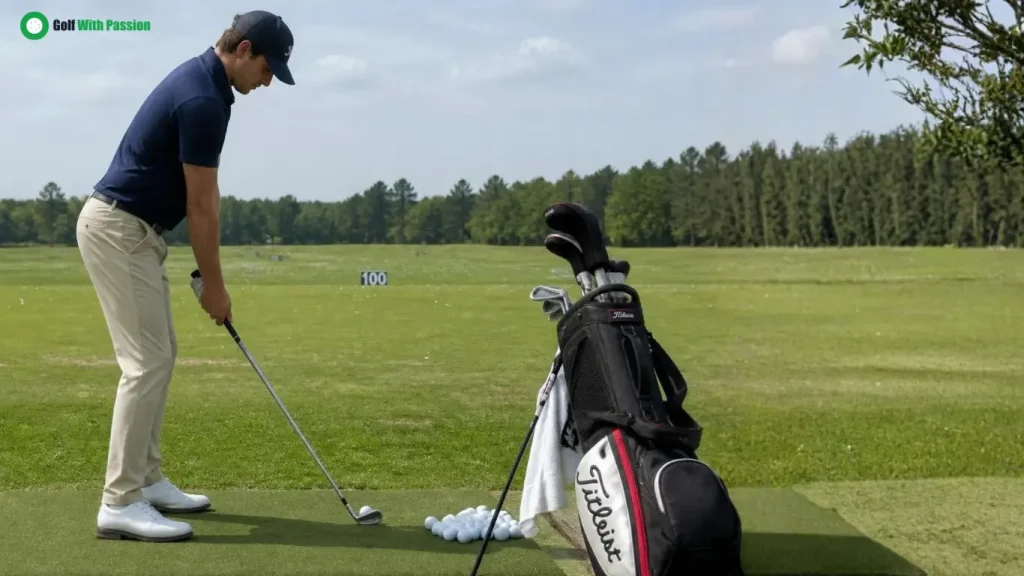
For many beginners, the driving range is the perfect place to get started.
You can practice repeatedly without worrying about slowing down a group behind you.
It also gives you a chance to experiment with different clubs and get comfortable standing over the ball.
But there’s a better way to practice than simply hitting drivers for an hour.
Try this progression.
Step 1: Short Pitches
Start with a wedge and hit small shots.
Focus on clean contact and controlling the distance.
Step 2: Half Swings
Gradually increase the length of your swing.
Don’t worry about how far the ball travels.
Step 3: Mid-Irons
Move to a 7-iron or similar club.
Work on consistent contact and direction.
Step 4: Longer Clubs
Once you feel more comfortable, try a hybrid, fairway wood, and eventually your driver.
Step 5: Finish With Short Shots
End your session with wedges or putting if the facility allows it.
This gives you a chance to finish with controlled shots rather than ending after a series of frustrating driver swings.
Learn the Different Types of Golf Shots
Golf involves much more than hitting a ball as far as possible.
You’ll encounter different situations during almost every round, so understanding the basic shot types is useful.
Drive
A drive is generally the first shot on a par-4 or par-5 hole.
It’s usually hit with a driver from a tee and is designed to cover a long distance.
Approach Shot
An approach shot is played toward the green.
Depending on the distance and situation, you might use an iron, hybrid, fairway wood, or wedge.
Pitch Shot
A pitch is a relatively short shot that travels through the air and lands on or near the green.
Chip Shot
A chip is generally a lower shot that lands on the green and rolls toward the hole.
Learning to chip is important because beginners will miss greens. That’s simply part of the game.
The ability to recover with a good chip can save several strokes.
Bunker Shot
A bunker shot is played from sand.
You don’t need to master bunker play during your first practice session, but it’s a useful skill to learn once you’re comfortable with basic chipping and pitching.
Putt
Putting happens on the green and is done with a putter.
The goal is to roll the ball into the hole.
Putting may look simple, but small improvements on the greens can make a noticeable difference to your score.
Understanding Golf Scoring
Golf scoring is based on the number of strokes you take.
Suppose you’re playing a par-4 hole.
- 4 strokes = Par
- 3 strokes = Birdie
- 5 strokes = Bogey
- 6 strokes = Double bogey
Here are some common golf scoring terms:
| Term | Meaning |
| Ace | Hole-in-one |
| Eagle | Two strokes under par |
| Birdie | One stroke under par |
| Par | Score equal to par |
| Bogey | One stroke over par |
| Double bogey | Two strokes over par |
| Triple bogey | Three strokes over par |
As a beginner, don’t be surprised if your score contains plenty of bogeys and double bogeys.
Your early rounds are about learning how to play the course, make decisions, and manage your game.
The lower scores will come with experience.
Basic Golf Rules for Beginners
You don’t need to memorize every golf rule before playing your first round.
Start with the basics.
Play the Ball as It Lies
In general, you play the ball from where it comes to rest unless the Rules of Golf allow you to take relief.
Count Your Strokes
Keep an accurate score.
If you’re unsure whether something counts as a penalty or how to proceed, ask your playing partner or a golf professional.
Out of Bounds
If your ball goes out of bounds, the applicable rules determine how you continue play and whether a penalty applies.
Lost Ball
If you can’t find your ball within the permitted search period, there are specific procedures for continuing play.
Penalty Areas
Courses may have marked penalty areas, often around water or other difficult areas.
The Rules of Golf provide options for taking relief.
If you’re playing your first few rounds with an experienced golfer, don’t be afraid to ask questions.
It’s much easier to learn rules when you’re seeing them happen on an actual golf course.
Golf Etiquette Every Beginner Should Know
Good golf etiquette isn’t complicated, but it matters.
You don’t need to be an experienced golfer to make a good impression on the course.
Be Quiet When Someone Is Hitting
When another golfer is preparing to hit, avoid talking, shouting, or making unnecessary noise.
Give them the same consideration you’d want while taking your own shot.
Keep Up With the Group Ahead
Try to maintain a reasonable pace of play.
If your group is falling far behind the group ahead, look for ways to move more efficiently.
Take Care of the Course
Depending on the course and situation, this may include:
- Repairing ball marks on greens
- Raking bunkers
- Replacing or repairing divots
- Following cart-path rules
- Treating the course with care
Don’t Walk Across Another Player’s Putting Line
Avoid walking directly across another golfer’s likely putting path.
It’s a small courtesy that experienced golfers appreciate.
Shout “Fore!”
If you hit a shot that could potentially reach another person, shout “Fore!” immediately.
Don’t wait to see where the ball lands.
The warning gives people nearby a chance to protect themselves.
When Should You Play Your First Round?
You don’t need a perfect golf swing before playing on a course.
Once you understand the basic safety rules, etiquette, and fundamentals, you can start looking for a beginner-friendly course.
For many new golfers, nine holes is a better introduction than jumping straight into 18.
Consider starting with:
- A par-3 course
- A short course
- A beginner-friendly nine-hole course
- A quieter time of day
- A twilight round, if permitted
- A round with an experienced friend
Your first round probably won’t go exactly as planned.
You may lose balls. You may hit terrible shots. You may take three or four putts on a hole.
That’s okay.
Don’t measure the success of your first round by your score.
Instead, focus on learning how the course works, keeping up with your group, staying safe, and enjoying the experience.
Common Beginner Golf Mistakes
Learning golf involves plenty of trial and error.
Here are some mistakes that many beginners make.
Trying to Hit Too Hard
More effort doesn’t always mean more distance.
If you swing too hard, you may lose your balance and make poor contact.
Start with a controlled swing and focus on finding the center of the clubface.
Buying Too Much Equipment
You don’t need every club, gadget, launch monitor, training aid, or accessory when you’re starting.
Learn the game first.
Then decide what equipment could actually help you.
Only Practicing the Driver
The driver is fun, but it’s only one part of golf.
Spend time practicing irons, wedges, chipping, and putting too.
Ignoring Putting
Putting may not be as exciting as hitting a long drive, but those short strokes add up.
A few extra putts on every hole can quickly inflate your score.
Constantly Changing Your Swing
There is an enormous amount of golf advice online.
One video may tell you to change your grip. Another may suggest changing your backswing. A third may recommend something completely different.
If you change your technique every few days, it becomes difficult to build consistency.
Pick a sensible approach and give yourself enough time to practice it.
If possible, work with a qualified instructor rather than trying to rebuild your entire swing from random online tips.
Focusing Too Much on Your Score
Your score matters, but it isn’t the only way to measure progress.
You can also track:
- Fairways hit
- Greens reached
- Penalty shots
- Putts
- Solid contact
- Quality of your decision-making
These numbers can help you understand where you actually need to improve.
A Simple Golf Practice Routine
You don’t need to spend three hours at the driving range every week.
A focused one-hour session can be useful if you have a clear plan.
10 Minutes: Putting
Start with short putts from different distances.
Focus on starting the ball on your intended line.
15 Minutes: Chipping
Use a wedge and practice different landing distances.
Try to learn how far the ball travels through the air and how much it rolls afterward.
15 Minutes: Short and Mid-Irons
Start with controlled swings.
Focus on contact rather than distance.
10 Minutes: Longer Clubs
Work on your hybrid, fairway wood, or driver.
Keep your focus on balance and direction.
10 Minutes: Review
Finish by working on the shot or club that gave you the most trouble.
This kind of structured practice is generally more useful than hitting balls randomly for an hour.
How Long Does It Take to Get Good at Golf?
There’s no universal timeline for learning golf.
Everyone progresses differently.
Your development can depend on:
- How frequently you practice
- How often you play
- Whether you take lessons
- Your coordination and mobility
- The quality of instruction
- How you structure your practice
- How consistently you work on the fundamentals
You may become comfortable playing nine holes relatively quickly.
Building a reliable full swing and consistently shooting lower scores can take much longer.
Instead of asking:
“How long will it take me to get good at golf?”
Ask:
“What’s the next part of my game I need to improve?”
That keeps your attention on something you can actually work on.
How to Improve Your Golf Game
Once you’ve learned the basics, improving becomes less about simply hitting more balls and more about practicing the right things.
Take a Golf Lesson
A qualified golf instructor can spot problems in your swing that you may not notice yourself.
Even a few lessons can help you understand the fundamentals and avoid building habits that are difficult to change later.
Practice With a Purpose
Don’t just go to the range and hit 100 balls.
Choose one thing to work on.
For example:
“Today I’m going to focus on making consistent contact with my 7-iron.”
That’s much easier to work on than simply trying to “hit better.”
Develop a Pre-Shot Routine
Before each shot, follow a simple routine:
- Pick your target.
- Choose your club.
- Visualize the shot.
- Take your stance.
- Swing.
Your routine doesn’t need to take long.
The goal is to make your preparation consistent so you spend less time second-guessing yourself.
Learn Course Management
Golf isn’t just about swing technique.
You also need to make good decisions.
Sometimes the smartest shot isn’t the most aggressive one.
For example, if water is directly in front of a green, you might decide to lay up rather than attempt a risky shot.
Learning when to take a chance and when to play safely can become an important part of your game.
Work on Your Short Game
Don’t ignore chipping, pitching, and putting.
You don’t always need to hit the ball farther to lower your score.
Improving your ability to recover after a poor approach shot can make a real difference.
A Beginner’s 30-Day Golf Plan
If you’ve never played golf before, here’s a simple four-week plan to get started.
Week 1: Learn the Fundamentals
Focus on:
- Grip
- Stance
- Posture
- Ball position
- Short swings
- Basic putting
Try to practice two or three times.
Don’t worry about distance.
Week 2: Work on Ball Striking
Practice:
- Half swings
- 9-iron
- 7-iron
- Wedges
- Basic chipping
Your main goal is consistent contact.
Week 3: Introduce Longer Clubs
Start working with:
- Hybrid
- Fairway wood
- Driver
Keep the focus on balance and direction rather than maximum distance.
Week 4: Play Your First Round
Now get onto a beginner-friendly course.
Nine holes is a great place to start if that’s available to you.
After your round, think about three things that caused you the most trouble.
Maybe you struggled with putting.
Maybe you lost several balls off the tee.
Maybe you had difficulty with short chips.
Whatever the problems were, use them to decide what you’ll practice next.
Frequently Asked Questions About Starting Golf
What should a beginner learn first in golf?
Start with the basics: grip, stance, posture, ball position, and a simple swing. You should also introduce putting and chipping early because they’re important parts of the game.
Can I learn golf without lessons?
Yes.
You can learn the basics through practice, books, videos, and other instructional resources.
However, a qualified golf instructor can help you identify mistakes early and build better fundamentals.
Do I need a full set of golf clubs?
No.
A smaller beginner-friendly set is enough to get started.
You can add clubs later when you understand your game and equipment preferences better.
Is golf expensive for beginners?
It can be, but there are ways to reduce the cost.
Used clubs, affordable golf balls, public courses, driving ranges, and group lessons can all make golf more accessible.
How often should a beginner practice golf?
Two or three focused practice sessions per week can be a good starting point.
You don’t necessarily need long sessions. Consistent practice with a clear goal can be more useful than spending hours hitting balls without a plan.
Should I learn to hit a driver first?
Not necessarily.
Learning basic irons, wedges, chipping, and putting can give you a better foundation.
Once you’re comfortable with those skills, you can gradually spend more time with the driver.
How many golf balls should I bring?
For practice, bring enough balls for the facility and the amount of practice you plan to do.
For a round of golf, carry several spare balls. Beginners often lose a few during their first rounds.
Can I play golf if I’m not athletic?
Yes.
You don’t have to be exceptionally athletic to enjoy golf.
Balance, coordination, basic technique, and good decision-making are more important than raw strength.
What should I wear for golf?
Wear comfortable clothing that allows you to move freely.
Before visiting a golf course, check its dress code. Requirements can vary between public courses, resorts, and private clubs.
Should I start with nine or 18 holes?
For many beginners, nine holes is a more manageable introduction.
It’s shorter, takes less time, and can feel less tiring while you’re still learning how to play.
Start Small and Enjoy the Game
Learning how to start playing golf doesn’t require a perfect swing, an expensive set of clubs, or months of preparation.
Start with the basics.
Learn how to grip the club. Get comfortable with your stance. Practice short shots. Spend time putting. Gradually introduce longer clubs, then take those skills onto a beginner-friendly course.
Most importantly, don’t be afraid to be a beginner.
You’re going to hit bad shots.
You’re going to lose golf balls.
You’ll probably miss a few putts that looked almost impossible to miss.
That’s part of learning golf.
The more you play, the more comfortable you’ll become. You’ll start to understand your swing, recognize your strengths and weaknesses, and make better decisions on the course.
So grab a few clubs, find a driving range or beginner-friendly course, and give golf a chance.